Kaduna State governor, Uba Sani, has unveiled a ₦34 billion intervention project to address long-standing gully erosion and environmental degradation affecting Rigasa and neighbouring communities in Kaduna South and Igabi Local Government Areas.
The project, which will be executed through the Ministry of Environment and Natural Resources, covers a 17-kilometre erosion corridor that has for decades threatened homes, farmlands and critical infrastructure in the affected communities.
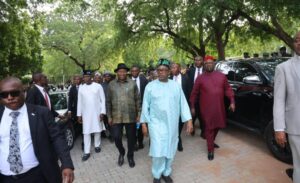
Speaking after an inspection of the site, Governor Sani described the erosion challenge as a persistent environmental crisis that has lasted for more than 30 years, leading to loss of lives, destruction of property and widespread economic hardship.
He said the intervention goes beyond environmental restoration, stressing that it is fundamentally a human development project aimed at safeguarding lives, restoring livelihoods and creating employment opportunities.
“This intervention is more than an environmental project; it is a human development project. It is about protecting lives, preserving livelihoods, creating jobs and ensuring that every citizen can live and work in a safe and healthy environment,” Sani said.
The governor disclosed that funding for the project has already been secured, adding that construction work is expected to begin within two weeks, while completion is projected within 18 months.
He further revealed that although more than 1,200 households would be affected by the construction work, the state government has set aside over ₦2 billion for compensation and resettlement support.
According to him, the ₦34 billion investment reflects his administration’s determination to confront long-standing environmental challenges that have continued to impact the welfare of residents.
“The ₦34 billion investment demonstrates our administration’s commitment to addressing long-neglected challenges that directly affect the welfare of our citizens. We are determined to deliver lasting solutions, not temporary fixes,” he said.
Sani added that the project is expected to generate employment, stimulate local economic activity and directly benefit more than two million residents and businesses within the affected corridor and surrounding areas.
“For too long, erosion defined the future of these communities. Today, we are changing that narrative. We are reclaiming the land, restoring livelihoods, protecting lives and building a safer and more prosperous future for over two million people,” he added.
A community leader, Yusuf Wada Muhammad, said the erosion crisis had severely impacted residents, destroying homes, farmlands and properties worth millions of naira, while exposing families to constant danger.